2023年5月4日星期四

Lesson 40 Who's who 真假难辨 NCE340

 Lesson 40 Who's who 真假难辨

谁也弄不清为什么大学生好像比任何人都更喜欢恶作剧。大学生擅长一种特殊的恶作剧——戏弄人。请消防队来扑灭一场根本没有的大火是一种低级骗局,有自尊心的大学生决不会去做。大学生们常常做的是制造一种可笑的局面,使大家笑上一场,当然受害者是笑不出来的。

 最近有个学生看见两个工人在大学校门外用风钻干活,马上打电话报告警察,说有两个学生装扮成工人,正在用风钻破坏路面。挂上电话后,他又马上来到工人那儿,告诉他们若有个警察来让他们走开,不要把他当回事;还对工人说,有个学生常装扮成警察无聊地同别人开玩笑。警察与工人都对那个学生事先通报情况表示感谢。

 那学生躲在附近一拱形门廊里,在那儿可以看见、听到现场发生的一切。果然,警察来了,有礼貌地请工人离开此地;但其中一个工人粗鲁地回了几句。于是警察威胁要强行使他们离开。工人说,悉听尊便。警察去打电话叫人。一会儿工夫,又来了4个警察,规劝工人离开。由于工人拒绝停下手中的活,警察想夺风钻。两个工人奋力抗争,其中一个发了火,威胁说要去叫警察。警察听后讥讽地说,这大可不必,因为他俩已被逮捕了。其中一个工人装模作样地问道,在被带往警察局之前,是否可以打一个电话。警察同意了,陪他来到一个投币电话前。当他看到那个工人真的是给警察挂电话,才恍然大悟,原来他们都成了一场骗局的受害者。

It has never been explained why university students seem to enjoy practical jokes more than anyone else. Students specialize in a particular type of practical joke: the hoax. Inviting the fire brigade to put out a nonexistent fire is a crude form of deception which no self-respecting student would ever indulge in. Students often create amusing situations which are funny to everyone except the victims. 

When a student recently saw two workmen using a pneumatic drill outside his university, he immediately telephoned the police and informed them that two students dressed up as workmen were tearing up the road with a pneumatic drill. As soon as he had hung up, he went over to the workmen and told them that if a policeman ordered them to go away, they were not to take him seriously. He added that a student had dressed up as a policeman and was playing all sorts of silly jokes on people. Both the police and the workmen were grateful to the student for this piece of advance information. 

The student hid in an archway nearby where he could watch and hear everything that went on. Sure enough, a policeman arrived on the scene and politely asked the workmen to go away. When he received a very rude reply from one of the workmen, he threatened to remove them by force. The workmen told him to do as he pleased and the policeman telephoned for help. Shortly afterwards, four more policemen arrived and remonstrated with the workmen. As the men refused to stop working, the police attempted to seize the pneumatic drill. The workmen struggled fiercely and one of them lost his temper. He threatened to call the police. At this, the police pointed out ironically that this would hardly be necessary as the men were already under arrest. Pretending to speak seriously, one of the workmen asked if he might make a telephone call before being taken to the station. Permission was granted and a policeman accompanied him to a pay phone. Only when he saw that the man was actually telephoning the police did he realize that they had all been the victims of a hoax.


Lesson 39 Nothing to worry about 不必担心 NCE339

 Lesson 39 Nothing to worry about 不必担心

穿越平原的道路高低不平,开车走了不远,路面愈加崎岖。我们想劝说布鲁斯把车开回到我们出发的那个村庄去。尽管路面布满石头,坑坑洼洼,但布鲁斯却一点儿不慌乱。他瞥了一眼地图,告诉我们前面再走不到20英里就是一个村庄。这并不是说布鲁斯总是低估困难,而是他压根儿没有一点儿危险感。他认为不管路面情况如何,车必须以最高速度前进。

 我们在尘土飞扬的道路上颠簸,车子东拐西弯,以躲开那些大圆石。车轮搅起的石块锤击车身,发出不祥的锤击声。我们相信迟早会飞起一个石块把油箱砸开一个窟窿,或者把发动机砸坏。因此,我们不时地掉过头,怀疑车后是否留下了机油和汽油的痕迹。

 突然大石块不见了,前面是一片平地,唯一的障碍只有一簇簇灌木丛。这使我们长长地松了口气。但是更糟糕的事情在等着我们,离我们不远处,出现了一个大裂缝。我们再次央求布鲁斯小心,他这才把车停了下来。我们纷纷下车察看那个大裂缝,他却呆在车上。我们告诉他那个大裂缝长50码,宽2英尺,深4英尺。这也没有对他产生任何影响。布鲁斯挂上慢档,把两只前轮分别搁在裂缝的两边,顺着弯弯曲曲的裂缝,以发疯的速度向前开去。我们还未来得及担心后果,车已重新开上了平地。布鲁斯又看了一眼地图,告诉我们那座村庄离我们只有15英里了。下一个障碍是一片约半英里宽的浅水塘。布鲁斯向水塘冲去,但车开到水塘当中,嘎吱一声停住了。仪表盘上一盏黄灯闪着刺眼的光芒,布鲁斯兴致勃勃地宣布发动机里没油了!

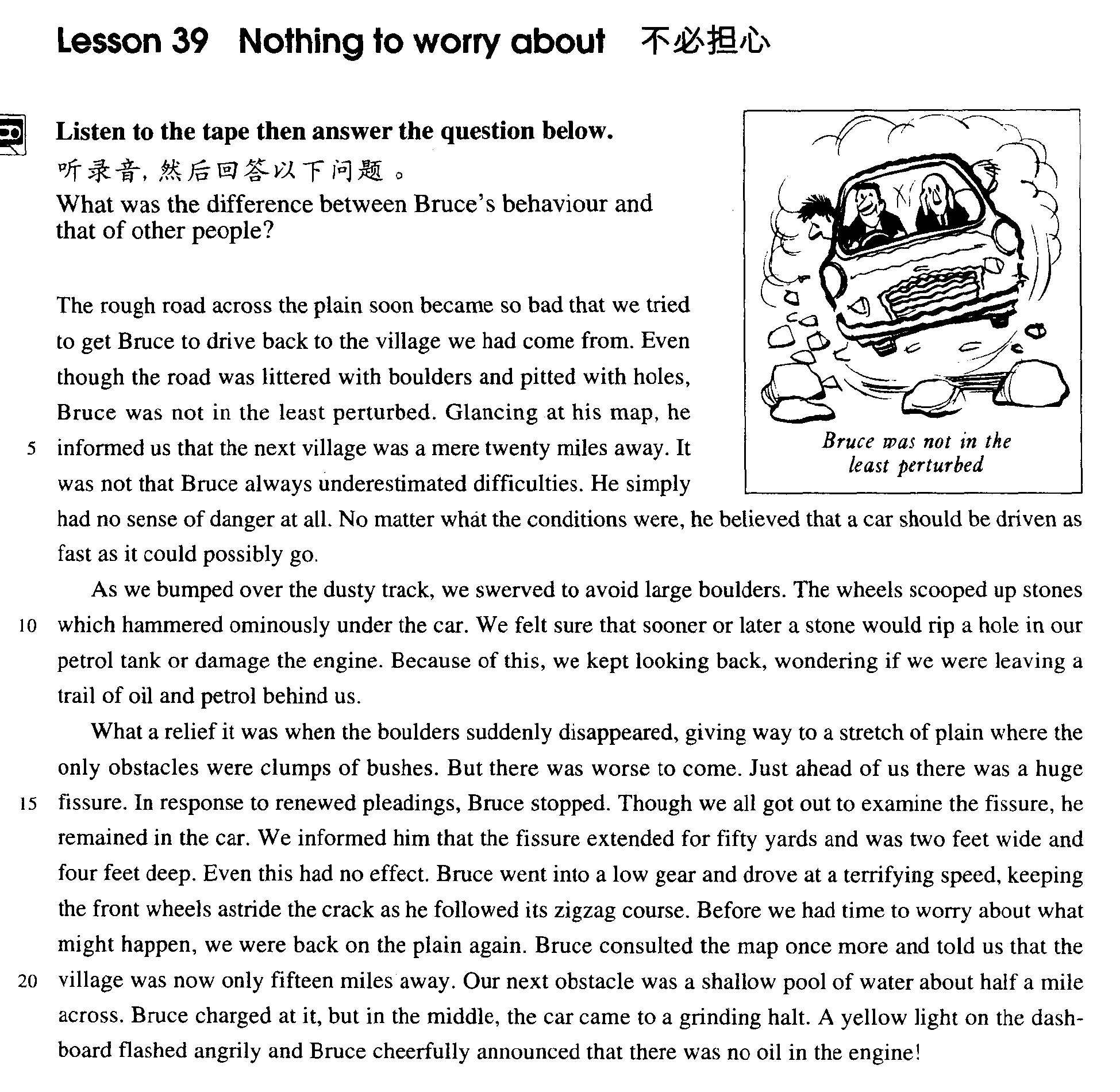
The rough road across the plain soon became so bad that we tried to get Bruce to drive back to the village we had come from. Even though the road was littered with boulders and pitted with holes, Bruce was not in the least perturbed. Glancing at his map, he informed us that the next village was a mere twenty miles away. It was not that Bruce always underestimated difficulties. He simply had no sense of danger at all. No matter what the conditions were, he believed that a car should be driven as fast as it could possibly go.

 As we bumped over the dusty track, we swerved to avoid large boulders: The wheels scooped up stones which hammered ominously under the car. We felt sure that sooner or later a stone would rip a hole in our petrol tank or damage the engine. Because of this, we kept looking back, wondering if we were leaving a trail of oil and petrol behind us.

 What a relief it was when the boulders suddenly disappeared, giving way to a stretch of plain where the only obstacles were clumps of bushes. But there was worse to come. Just ahead of us there was a huge fissure. In response to renewed pleadings, Bruce stopped. Though we all got out to examine the fissure, he remained in the car. We informed him that the fissure extended for fifty yards and was two feet wide and four feet deep. Even this had no effect. Bruce went into a low gear and drove at a terrifying speed, keeping the front wheels astride the crack as he followed its zigzag course. Before we had time to worry about what might happen, we were back on the plain again. Bruce consulted the map once more and told us that the village was now only fifteen miles away. Our next obstacle was a shallow pool of water about half a mile across. Bruce charged at it, but in the middle, the car came to a grinding halt. A yellow light on the dashboard flashed angrily and Bruce cheerfully announced that there was no oil in the engine!


Lesson 38 The first calendar 最早的日历 NCE338

 Lesson 38 The first calendar 最早的日历

未来的历史学家在写我们这一段历史的时候会别具一格。对于逐渐积累起来的庞大材料,他们几乎不知道选取哪些好,而且,也不必完全依赖文字材料。电影、录像、光盘和光盘驱动器只是能为他们提供令人眼花缭乱的大量信息的几种手段。他们能够身临其境般地观看我们做事,倾听我们讲话。但是,历史学家企图重现遥远的过去可是一项艰巨的任务,他们必须根据现有的不充分的线索进行推理。即使看起来微不足道的遗物,也可能揭示人类早期历史中的一些有趣的内容。 历史学家迄今认为日历是随农业的问世而出现的,因为当时人们面临着了解四季的实际需要。但近期科学研究发现,好像这种假设是不正确的。 

长期以来,历史学家一直对雕刻在墙壁上、骨头上、古代长毛象的象牙上的点、线和形形色色的符号感到困惑不解。这些痕迹是游牧人留下的,他们生活在从公元前约 35,000年到公元前10,000年的冰川期的末期,以狩猎、捕鱼为生。历史学家通过把世界各地留下的这种痕迹放在一起研究,终于弄懂了这种费解的代码。他们发现代码与昼夜更迭和月亮圆缺有关,事实上是一种最原始的日历。大家早就知道,画在墙上的狩猎图景并不是单纯的艺术表现形式,它们有着一定的含义,因为它们已接近古代人的文字形式。有时,这种图画与墙壁上的刻痕共存,它们之间可能有一定的联系。看来人类早就致力于探索四季变迁了,比人们想像的要早20,000年。

Future historians will be in a unique position when they come to record the history of our own times. They will hardly know which facts to select from the great mass of evidence that steadily accumulates. What is more, they will not have to rely solely on the written word. Films, videos, CDs and CD-ROMs are just some of the bewildering amount of information they will have. They will be able, as it were, to see and hear us in action. But the historian attempting to reconstruct the distant past is always faced with a difficult task. He has to deduce what he can from the few scanty clues available. Even seemingly insignificant remains can shed interesting light on the history of early man. 

Up to now, historians have assumed that calendars came into being with the advent of agriculture, for then man was faced with a real need to understand something about the seasons. Recent scientific evidence seems to indicate that this assumption is incorrect. Historians have long been puzzled by dots, lines and symbols which have been engraved on walls, bones, and the ivory tusks of mammoths. The nomads who made these markings lived by hunting and fishing during the last Ice Age which began about 35, 000 B. C. and ended about 10, 000 B. C. By correlating markings made in various parts of the world, historians have been able to read this difficult code. They have found that it is connected with the passage of days and the phases of the moon. It is, in fact, a primitive type of calendar. It has long been known that the hunting scenes depicted on walls were not simply a form of artistic expression. They had a definite meaning, for they were as near as early man could get to writing. It is possible that there is a definite relation between these paintings and the markings that sometimes accompany them. It seems that man was making a real effort to understand the seasons 20, 000 years earlier than has been supposed.


Lesson 37 The Westhaven Express 开往威斯特海温的快车 NCE337

 Lesson 37 The Westhaven Express 开往威斯特海温的快车

我们已经习惯于相信火车总是准点的。经过多年的适应,大多数人对火车时刻表产生了一种不可动摇的信念。轮船船期可能因风暴而推延,飞机航班可能因恶劣天气而取消,唯有火车必然是准点的。只有非同寻常的大雪才可能暂时打乱铁路运行。因此,一旦铁路上真出了问题,人们便不加思索地责备铁路当局。事实上,差错很可能是我们自己,而不是铁路当局的。

 我查看了列车时刻表,满意地了解到有一趟去威斯特海温的快车。这是趟直达车,旅途总共才需1小时17分钟。上车后,我不禁注意到许多当地人也上了车。一开始,我并不感到奇怪,我想除我之外,想利用快车之便的也一定大有人在。火车开出几英里即在一个小站威德里停了下来。对此,我不觉得奇怪,因为即便是特别快车也可能被信号拦住。但是,当火车一站接着一站往前蠕动时,我便产生了怀疑。我突然感到这趟快车并没以时速90英里的速度呼啸前进,而是卟哧卟哧地向前爬行,时速仅30英里。1小时17分过去了,走了还不到一半路程。我问一位乘客,这是不是开往威斯特海温的那趟快车,他说从未听说过有这么一趟快车。我决定一到目的地就给铁路部门提意见。两小时后,我气呼呼地同威斯特海温站站长说起此事。他说根本没有这趟车。于是我借了他本人的列车时刻表,我带着一种胜利者的调子告诉他那趟车白纸黑字、明明白白印在时刻表上。他迅速地扫视了一眼,让我再看一遍。一个小小的星形符号把我的目光引到了那页底部的一个说明上。上面写着:“此趟列车暂停运行。”

We have learnt to expect that trains will be punctual. After years of conditioning, most of us have developed an unshakable faith in railway timetables. Ships may be delayed by storms; flights may be cancelled because of bad weather; but trains must be on time. Only an exceptionally heavy snowfall might temporarily dislocate railway services. It is all too easy to blame the railway authorities when something does go wrong. The truth is that when mistakes occur, they are more likely to be ours than theirs. 

After consulting my railway timetable, I noted with satisfaction that there was an express train to Westhaven. It went direct from my local station and the journey lasted a mere hour and seventeen minutes. When I boarded the train, I could not help noticing that a great many local people got on as well. At the time, this did not strike me as odd. I reflected that there must be a great many people besides myself who wished to take advantage of this excellent service. Neither was I surprised when the train stopped at Widley, a tiny station a few miles along the line. Even a mighty express train can be held up by signals. But when the train dawdled at station after station, I began to wonder. It suddenly dawned on me that this express was not roaring down the line at ninety miles an hour, but barely chugging along at thirty. One hour and seventeen minutes passed and we had not even covered half the distance. I asked a passenger if this was the Westhaven Express, but he had not even heard of it. I determined to lodge a complaint as soon as we arrived. Two hours later, I was talking angrily to the station master at Westhaven. When he denied the train's existence, I borrowed his copy of the timetable. There was a note of triumph in my voice when I told him that it was there in black and white. Glancing at it briefly, he told me to look again. A tiny asterisk conducted me to a footnote at the bottom of the page. It said: ‘This service has been suspended. ’


Lesson 36 A chance in a million 百万分之一的机遇 NCE336

 Lesson 36 A chance in a million 百万分之一的机遇

我们不再像以往那样轻易相信别人了。在19世纪,小说家常在小说结尾处给读者准备一系列巧合——大部分是牵强附会,极不可能的。当时的读者却愉快地接受这样一些事实:一个低贱的女佣实际上是主人公的母亲;主人公一位长期失散的兄弟,大家都以为死了,实际上一直活着,并且正在策划暗算主人公;如此等等。现代读者会觉得这种天真的结局完全无法接受。不过,在现实生活中,有时确实会出现一些巧合。这些巧合除了19世纪小说家外谁也不会相信。

 当我是个孩子的时候,我祖父给我讲了一位德国出租汽车司机弗朗兹·巴斯曼如何找到了据信已在20年前死去的兄弟的事。一次,他与妻子徒步旅行。途中,停下来与一个工人交谈,接着他们继续往前走去。巴斯曼夫人说那工人与她丈夫相貌很像,甚至猜测他可能就是她丈夫的兄弟。弗朗兹对此不屑一顾,指出他兄弟已经在战争中阵亡了。尽管巴斯曼夫人熟知这个情况,但她仍然认为自己的想法仍有百万分之一的可能性。几天后,她派了一个男孩去问那人是否叫汉斯·巴斯曼。不出巴斯曼夫人所料,那人的名字真是汉斯·巴斯曼,他确实是弗朗兹失散了多年的兄弟。兄弟俩团聚之时,汉斯说明了他活下来的经过。战争即将结束时,他负伤被送进医院,并与部队失去联系。医院遭到轰炸,汉斯步行回到了西德。与此同时,他所在的部队被击溃,他的所有档案材料全部毁于战火。汉斯重返故里,但他的家已被炸毁,左邻右舍谁也不知原住户的下落。汉斯以为全家人都在空袭中遇难,于是便在距此50英里外的一座村子里定居下来,直至当日。

We are less credulous than we used to be. In the nineteenth century, a novelist would bring his story to a conclusion by presenting his readers with a series of coincidences ---- most of them wildly improbable. Readers happily accepted the fact that an obscure maidservant was really the hero's mother. A long-lost brother, who was presumed dead, was really alive all the time and wickedly plotting to bring about the hero's downfall. And so on. Modern readers would find such naive solutions totally unacceptable. Yet, in real life, circumstances do sometimes conspire to bring about coincidences which anyone but a nineteenth century novelist would find incredible.

 When I was a boy, my grandfather told me how a German taxi driver, Franz Bussman, found a brother who was thought to have been killed twenty years before. While on a walking tour with his wife, he stopped to talk to a workman. After they had gone on, Mrs. Bussman commented on the workman's close resemblance to her husband and even suggested that he might be his brother. Franz poured scorn on the idea, pointing out that his brother had been killed in action during the war. Though Mrs. Bussman was fully acquainted with this story, she thought that there was a chance in a million that she might be right. A few days later, she sent a boy to the workman to ask him if his name was Hans Bussman. Needless to say, the man's name was Hans Bussman and he really was Franz's long-lost brother. When the brothers were reunited, Hans explained how it was that he was still alive. After having been wounded towards the end of the war, he had been sent to hospital and was separated from his unit. The hospital had been bombed and Hans had made his way back into Western Germany on foot. Meanwhile, his unit was lost and all records of him had been destroyed. Hans returned to his family home, but the house had been bombed and no one in the neighbourhood knew what had become of the inhabitants. Assuming that his family had been killed during an air raid, Hans settled down in a village fifty miles away where he had remained ever since.


Lesson 35 Justice was done 伸张正义 NCE335

 Lesson 35 Justice was done 伸张正义

“正义”这个词常常是同法庭连在一起的。当某人被证据确凿地证明无罪或有罪的时候,我们也许会说正义得到了伸张。正义是复杂的法律机器的组成部分。那些寻求正义的人走的是一条崎岖的道路,从来没有把握他们最终将找到正义。法官无论如何聪明与有名,毕竟也是人,也会出差错的。

 在个别情况下,正义不再是一种抽象概念。奖惩的实施是不受人的意志支配的。在这种时候,正义像一种有生命的力量行使其职能。当我们说“他罪有应得”这句话的时候,我们部分地承认了某种特定的环境使得正义自动地起了作用。

 一天上午,当一个小偷在一家大型珠宝店里被人抓住的时候,店员一定会忍不住说:“他罪有应得。”那是一座老式的、经过改造的房子,店里有许多废置不用的大壁炉和又高又窄的烟囱。快到中午的时候,一个女售货员听见从一堵墙里传出一种闷声闷气的叫声。由于这种喊叫声重复了几次,她跑去报告了经理,经理当即给消防队挂了电话。喊叫声肯定是从烟囱里传出来的,然而,因为烟囱太多,消防队员无法确定到底是哪一个。他们通过叩击烟囱倾听那人的喊叫声而确定了传出声音的那个烟囱。他们凿透了18英寸厚的墙壁,发现有个人卡在了烟囱里。由于烟囱太窄,那人无法动弹。消防队员在墙上挖了个大洞,才终于把他解救出来。那个看起来满脸沮丧、浑身漆黑的家伙从烟囱里一出来,就承认头天夜里他企图到店里行窃,但让烟囱卡住了。他已经在烟囱里被困了将近10个小时。甚至在那人还没被送交给警察之前,正义就已得到了伸张。

The word justice is usually associated with courts of law. We might say that justice has been done when a man's innocence or guilt has been proved beyond doubt. Justice is part of the complex machinery of the law. Those who seek it undertake an arduous journey and can never be sure that they will find it. Judges, however wise or eminent, are human and can make mistakes. 

There are rare instances when justice almost ceases to be an abstract concept. Reward or punishment are meted out quite independent of human interference. At such times, justice acts like a living force. When we use a phrase like ‘it serves him right’, we are, in part, admitting that a certain set of circumstances has enabled justice to act of its own accord. 

When a thief was caught on the premises of a large jewellery store one morning, the shop assistants must have found it impossible to resist the temptation to say ‘it serves him right’. The shop was an old converted house with many large, disused fireplaces and tall, narrow chimneys. Towards midday, a girl heard a muffled cry coming from behind one of the walls. As the cry was repeated several times, she ran to tell the manager who promptly rang up the fire brigade. The cry had certainly come from one of the chimneys, but as there were so many of them, the fire fighters could not be certain which one it was. They located the right chimney by tapping at the walls and listening for the man's cries. After chipping through a wall which was eighteen inches thick, they found that a man had been trapped in the chimney. As it was extremely narrow, the man was unable to move, but the fire fighters were eventually able to free him by cutting a huge hole in the wall. The sorry-looking, blackened figure that emerged, admitted at once that he had tried to break into the shop during the night but had got stuck in the chimney. He had been there for nearly ten hours. Justice had been done even before the man was handed over to the police.


Lesson 34 A happy discovery 幸运的发现 NCE334

 Lesson 34 A happy discovery 幸运的发现

古玩店对许多人来说有一种特殊的魅力。高档一点的古玩店为了防尘,把文物漂亮地陈列在玻璃柜子里,那里往往令人望而却步。而对不太装腔作势的古玩店,无论是谁都不用壮着胆子才敢往里进。人们还常常有希望在发霉、阴暗、杂乱无章、迷宫般的店堂里,从杂乱地摆放在地面上的、一堆堆各式各样的破烂货里找到一件稀世珍品。

 无论是谁都不会一下子就发现一件珍品。一个到处找便宜货买的人必须具有耐心,而且最重要的是看到珍品时要有鉴别珍品的能力。要做到这一点,他至少要像古董商一样懂行。他必须像一个专心致志进行探索的科学家那样抱有这样的希望,即终有一天,他的努力会取得丰硕的成果。

 我的老朋友弗兰克·哈利戴正是这样一个人。他多次向我详细讲他如何只花50英镑便买到一位名家的杰作。一个星期六的上午,弗兰克去了我家附近的一家古玩店。由于他从未去过那儿,结果他发现了许多有趣的东西。上午很快过去了,弗兰克正准备离去,突然看见地板上放着一只体积很大的货箱。古董商告诉他那只货箱刚到不久,但他嫌麻烦不想把它打开。经弗兰克恳求,古董商才勉强把货箱撬开了。箱内东西令人失望。除了一柄式样别致、雕有花纹的匕首外,货箱内装满了陶器,而且大部分都已破碎。弗兰克轻轻地把陶器拿出箱子,突然发现在箱底有一幅微型画,画面构图与线条使他想起了一幅他所熟悉的意大利画,于是他决定将画买下来。古董商漫不经心看了一眼那幅画,告诉弗兰克那画值50英镑。弗兰克几乎无法掩饰自己兴奋的心情,因为他明白自己发现了一件珍品。那幅不大的画原来是柯勒乔的一幅未被发现的杰作,价值几十万英镑。

Antique shops exert a peculiar fascination on a great many people. The more expensive kind of antique shop where rare objects are beautifully displayed in glass cases to keep them free from dust is usually a forbidding place. But no one has to muster up courage to enter a less pretentious antique shop. There is always hope that in its labyrinth of musty, dark, disordered rooms a real rarity will be found amongst the piles of assorted junk that litter the floors. 

No one discovers a rarity by chance. A truly dedicated bargain hunter must have patience, and above all, the ability to recognize the worth of something when he sees it. To do this, he must be at least as knowledgeable as the dealer. Like a scientist bent on making a discovery, he must cherish the hope that one day he will be amply rewarded. 

My old friend, Frank Halliday, is just such a person. He has often described to me how he picked up a masterpiece for a mere£50. One Saturday morning, Frank visited an antique shop in my neighbourhood. As he had never been there before, he found a great deal to interest him. The morning passed rapidly and Frank was about to leave when he noticed a large packing case lying on the floor. The dealer told him that it had just come in, but that he could not be bothered to open it. Frank begged him to do so and the dealer reluctantly prised it open. The contents were disappointing. Apart from an interesting-looking carved dagger, the box was full of crockery, much of it broken. Frank gently lifted the crockery out of the box and suddenly noticed a miniature painting at the bottom of the packing case. As its Composition and line reminded him of an Italian painting he knew well, he decided to buy it. Glancing at it briefly, the dealer told him that it was worth£50. Frank could hardly conceal his excitement, for he knew that he had made a real discovery. The tiny painting proved to be an unknown masterpiece by Correggio and was worth hundreds of thousands of pounds.


Lesson 33 A day to remember 难忘的一天 NCE333

 Lesson 33 A day to remember 难忘的一天

我们大家都有过事事不顺心的日子。一天开始时,可能还不错,但突然间似乎一切都失去了控制。情况经常是这样的,许许多多的事情都偏偏赶在同一时刻出问题,好像是一件无关紧要的小事引起了一连串的连锁反应。假设你在做饭,同时又在照看孩子。这时电话铃响了,它预示着一连串意想不到的灾难的来临。就在你接电话时,孩子把桌布从桌子上扯了下来,将家中最好的陶瓷餐具半数摔碎,同时也弄伤了他自己。你急急忙忙挂上电话,赶去照看孩子和餐具。这时,饭又烧糊了。好像这一切还不足以使你急得掉泪,你的丈夫接着回来了,事先没打招呼就带来3个客人吃饭。

 就像许多人最近在悉尼郊区帕拉马塔所发现的那样,有时乱子会闹得很大。一天傍晚交通最拥挤时,一辆汽车撞上前面一辆汽车,两个司机争吵起来。紧跟其后的一辆车上的司机碰巧是个初学者,她一惊之下突然把车停了下来。她这一停使得跟在后头的司机也来了个急刹车。司机的妻子正坐在他身边,手里托着块大蛋糕。她往前一冲,蛋糕从挡风玻璃飞了出去掉在马路上。此时,一辆卡车正好从后边开到那辆汽车边上,司机看见一块蛋糕从天而降,紧急刹车。卡车上装着空啤酒瓶,成百只瓶子顺势从卡车后面滑出车外落在马路上。这又引起了一场唇枪舌剑的争吵。与此同时,后面的车辆排成了长龙,警察花了将近一个小时才使车辆又开起来。在这段时间里,卡车司机不得不清扫那几百只破瓶子。只有两只野狗从这一片混乱中得到了好处,它们贪婪地吃掉了剩下的蛋糕。这就是事事不顺心的那么一天!

We have all experienced days when everything goes wrong. A day may begin well enough, but suddenly everything seems to get out of control. What invariably happens is that a great number of things choose to go wrong at precisely the same moment. It is as if a single unimportant event set up a chain of reactions. Let us suppose that you are preparing a meal and keeping an eye on the baby at the same time. The telephone rings and this marks the prelude to an unforeseen series of catastrophes. While you are on the phone, the baby pulls the tablecloth off the table, smashing half your best crockery and cutting himself in the process. You hang up hurriedly and attend to baby, crockery, etc. Meanwhile, the meal gets burnt. As if this were not enough to reduce you to tears, your husband arrives, unexpectedly bringing three guests to dinner.

 Things can go wrong on a big scale, as a number of people recently discovered in Parramatta, a suburb of Sydney. During the rush hour one evening two cars collided and both drivers began to argue. The woman immediately behind the two cars happened to be a learner. She suddenly got into a panic and stopped her car. This made the driver following her brake hard. His wife was sitting beside him holding a large cake. As she was thrown forward, the cake went right through the windscreen and landed on the road. Seeing a cake flying through the air, a lorry driver who was drawing up alongside the car, pulled up all of a sudden. The lorry was loaded with empty beer bottles and hundreds of them slid off the back of the vehicle and on to the road. This led to yet another angry argument. Meanwhile, the traffic piled up behind. It took the police nearly an hour to get the traffic on the move again. In the meantime, the lorry driver had to sweep up hundreds of broken bottles. Only two stray dogs benefited from all this confusion, for they greedily devoured what was left of the cake. It was just one of those days!


Lesson 32 A lost ship 一艘沉船 NCE332

 Lesson 32 A lost ship 一艘沉船

打捞工作彻底失败了。小船“埃尔科”号在巴伦支海搜寻了几个星期之后,正在返航途中。返航前,该船船长收到了大陆上发来的电报,指示他们放弃这次搜寻。船长知道日后还会再作尝试,因为他试图寻找的沉船上载有一批珍贵的金条。

 尽管船长接到了电报,他还是决定再试一试。他们用结实的网把海床搜索了一遍。当一只箱子从海底被打捞上来时,甲板上人们激动不已。船员们开始认为沉船找着了,但海底沉箱内的物品证明他们弄错了。事实上,他们发现的是另一艘沉没多年的船。

 木箱内装有水手艾伦·菲尔丁的私人财物,其中有书籍、衣服、照片以及水手收到的妻子的来信。“埃尔科”号船长命令船员尽量从沉船中打捞物品,但没发现什么值钱的东西,不过打捞出来的众多的物品还是引起了大家极大的兴趣。从捞起的一门大炮来看,船长认为那艘船一定是艘巡洋舰。另一只海底沉箱中装的是船上一位军官的财物,其中有一封写于1943年3月14日的信,但没有写完。从这封信中船长了解到沉船船名是“卡伦”号。打捞到的东西中最有价值的是船上的航海日志,其中有一部分仍然清晰可读。据此,船长可以将所有的那些已经搞清的材料拼凑起来。“卡伦”号当年在为其他船只护航驶往俄国途中突然遭到敌方潜水艇鱼雷的袭击。这一说法在“埃尔科”号返航后得到国防部一位海军官员的证实。那次打捞到的所有物品均被送往军事博物馆。

The salvage operation had been a complete failure. The small ship, Elkor, which had been searching the Barents Sea for weeks, was on its way home. A radio message from the mainland had been received by the ship's captain instructing him to give up the search. The captain knew that another attempt would be made later, for the sunken ship he was trying to find had been carrying a precious cargo of gold bullion. 

Despite the message, the captain of the Elkor decided to try once more. The sea bed was scoured with powerful nets and there was tremendous excitement on board when a chest was raised from the bottom. Though the crew were at first under the impression that the lost ship had been found, the contents of the chest proved them wrong. What they had in fact found was a ship which had been sunk many years before. 

The chest contained the personal belongings of a seaman, Alan Fielding. There were books, clothing and photographs, together with letters which the seaman had once received from his wife. The captain of the Elkor ordered his men to salvage as much as possible from the wreck. Nothing of value was found, but the numerous items which were brought to the surface proved to be of great interest. From a heavy gun that was raised, the captain realized that the ship must have been a cruiser. In another chest, which contained the belongings of a ship's officer, there was an unfinished letter which had been written on March 14th, 1943. The captain learnt from the letter that the name of the lost ship was the Karen. The most valuable find of all was the ship's log book, parts of which it was still possible to read. From this the captain was able to piece together all the information that had come to light. The Karen had been sailing in a convoy to Russia when she was torpedoed by an enemy submarine. This was later confirmed by a naval official at the Ministry of Defence after the Elkor had returned home. All the items that were found were sent to the War Museum.


Lesson 31 A lovable eccentric 可爱的怪人 NCE331

 Lesson 31 A lovable eccentric 可爱的怪人

真正古怪的人从不有意引人注意。他们不顾社会习俗,意识不到自己所作所为有什么特殊之处。他们总能赢得别人的喜爱与尊敬,因为他们给平淡单一的日常生活增添了色彩。

 理查德·科尔森生前是我们镇上最有名望的人之一。他是个精明能干、有钱的商人,但镇上大部分人对他生活中的这一个方面几乎一无所知。大家都管他叫迪基。早在他去世前很久,他的古怪行为就成了传奇故事了。

 迪基痛恨势利小人。尽管他有一辆豪华小轿车,但却很少使用,常常喜欢以步代车。即使大雨倾盆,他也总是拒绝带伞。一天,他遇上一场瓢泼大雨,淋得透湿。他走进一家高级商店,要为妻子买一块价值300英镑的手表。但店员见他浑身泥水的样子,竟不肯接待他。迪基二话没说就走了。一会儿,他带着一个大布口袋回到店里。布袋很沉,他重重地把布袋扔在柜台上。店员让迪基走开,他置之不理,并要求见经理。经理认出了这位顾客,表示了深深的歉意,还严厉地训斥了店员。店员为迪基拿出了那块手表,迪基把布口袋递给他,口袋里面装着300镑的便士。他坚持要店员点清那些硬币后他才离去。这些硬币加在一起共有30,000枚!还有一次,他邀请一些著名评论家来参观他私人收藏的现代画。这次展览引起报界广泛注意,因为这些画名义上是名家的作品,事实上是迪基自己画的。他花了4年时间策划这出精心设计的闹剧,只是想证明评论家们有时并不了解他们所谈论的事情。

True eccentrics never deliberately set out to draw attention to themselves. They disregard social conventions without being conscious that they are doing anything extraordinary. This invariably wins them the love and respect of others, for they add colour to the dull routine of everyday life. 

Up to the time of his death, Richard Colson was one of the most notable figures in our town. He was a shrewd and wealthy businessman, but most people in the town hardly knew anything about this side of his life. He was known to us all as Dickie and his eccentricity had become legendary long before he died. 

Dickie disliked snobs intensely. Though he owned a large car, he hardly ever used it, preferring always to go on foot. Even when it was raining heavily, he refused to carry an umbrella. One day, he walked into an expensive shop after having been caught in a particularly heavy shower. He wanted to buy a£300 watch for his wife, but he was in such a bedraggled condition that an assistant refused to serve him. Dickie left the shop without a word and returned carrying a large cloth bag. As it was extremely heavy, he dumped it on the counter. The assistant asked him to leave, but Dickie paid no attention to him and requested to see the manager. Recognizing who the customer was, the manager was most apologetic and reprimanded the assistant severely. When Dickie was given the watch, he presented the assistant with the cloth bag. It contained£300 in pennies. He insisted on the assistant's counting the money before he left ---- 30, 000 pennies in all! On another occasion, he invited a number of important critics to see his private collection of modern paintings. This exhibition received a great deal of attention in the press, for though the pictures were supposed to be the work of famous artists, they had in fact been painted by Dickie. It took him four years to stage this elaborate joke simply to prove that critics do not always know what they are talking about.


RP200 Rafflesia, the corpse Flower

 RP1100 Rafflesia, the corpse Flower Repulsive, foul, stinking—would you guess that all these adjectives apply to a flower? Rafflesia is the...